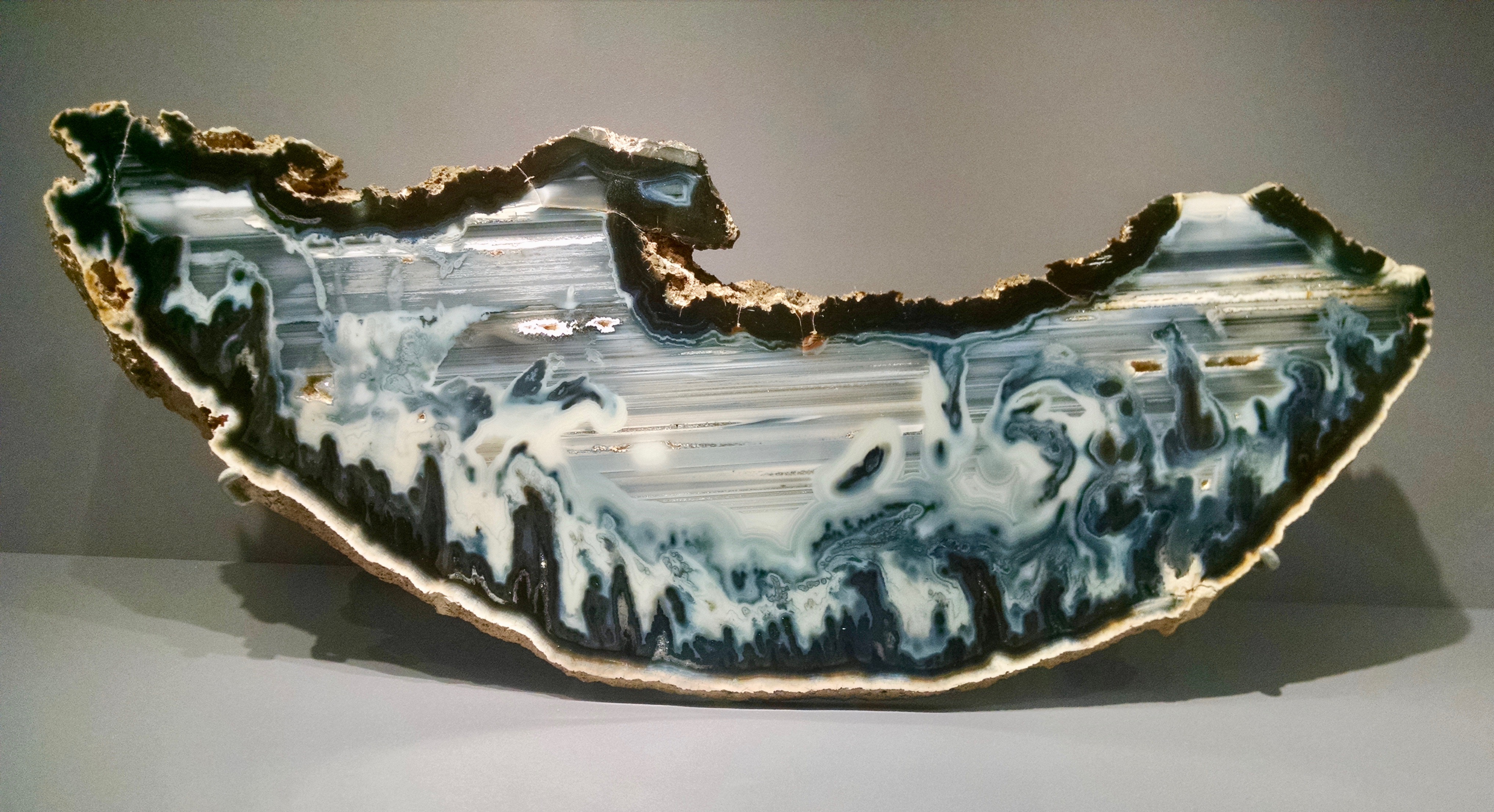
12018-08-04T19:59:47+00:00Paul A. Harris0462def817acd13db43634107b67e5f0f737f3f115Agate, Le Vaisseau (The Ship) 37 x 14.5 x 2cmplain2018-08-04T20:26:25+00:002015052515572720150525155727Paul A. Harris0462def817acd13db43634107b67e5f0f737f3f1
This page is referenced by:
12018-07-31T20:42:37+00:00Roger Caillois Mineral Collection29gallery12018-08-11T18:07:47+00:00Roger Caillois bequeathed his renowned mineral collection to the Muséum national d'Histoire naturelle in Paris. The collection, featured at the 2013 Venice Biennale, can be seen at the galerie de Minéralogie et de Géologie. The following pages present images of selected pieces from the collection, paired with passages from Caillois's The Writing of Stones (Trans. Barbara Bray, University of Virginia Press, 1985). This content supplements but also contextualizes the excerpts from Caillois's Pierres réfléchies featured in Rock Records, as well as treatments of Caillois in the issue by Jeffrey Jerome Cohen, Paul Prudence, and Paul A. Harris.
Caillois's opening words in The Writing of Stones provide a portal through which to enter this virtual gallery.
"Just as men have always sought after precious stones, so they have always prized curious ones, those that catch the attention through some anomaly of form, some suggestive oddity of color or pattern. Stones possess a kind of gravitas, something ultimate and unchanging, something that will never perish or else has already done so. They act through an intrinsic, infallible, immediate beauty, answerable to no one, necessarily perfect yet excluding the idea of perfection in order to exclude approximation, error, and excess. This spontaneous beauty thus precedes and goes beyond the actual notion of beauty, of which it is at once the promise and the foundation" (The Writing of Stones, 1-2).
12018-08-09T22:21:08+00:00"The Ship" (agate)4plain2018-08-10T20:54:19+00:00"I ... concern myself with... whether nature's offerings appear to represent something or are pure signs.... We have seen modern painters first give up trying to reproduce their models exactly, then abandon models altogether and eschew any kind of representation.... It is strange to think that nature, which can neither draw nor paint, sometimes creates the illusion of having done so, which art, which has always been successful at resemblances, renounces its traditional, almost inevitable and 'natural' vocation and turns to the creation of such forms as nature itself abounds in--mute, unpremeditated, and without a model" (The Writing of Stones, 13-14).