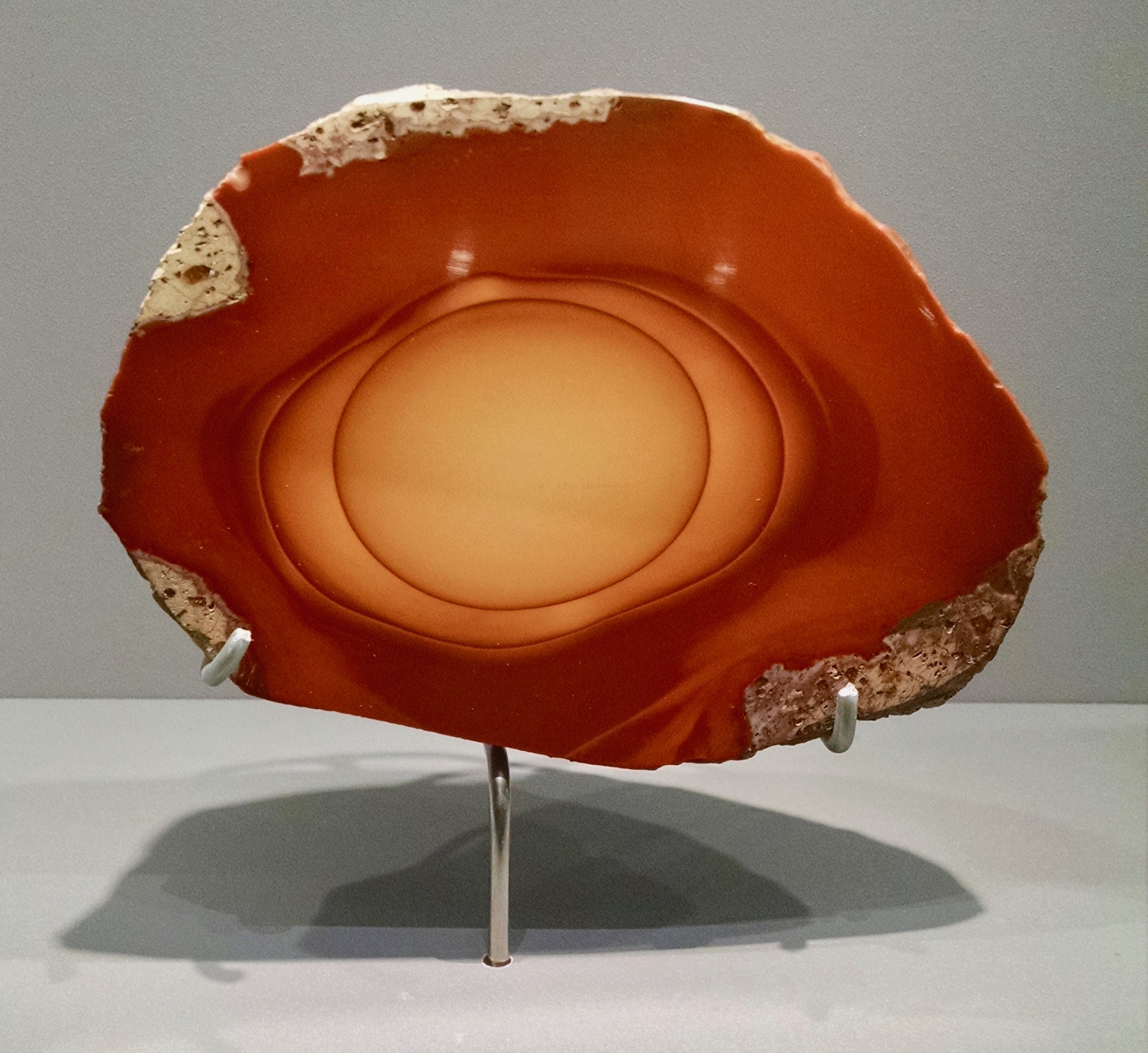
1media/Quartz jasper Orbit.jpg2018-08-04T20:32:15+00:00Paul A. Harris0462def817acd13db43634107b67e5f0f737f3f112Quartz jasper, "Orbit" Idaho, USA 12.5 x 8.5 x 3cmplain2018-08-04T20:32:39+00:002015052515464220150525154642Photo by Paul A. HarrisPaul A. Harris0462def817acd13db43634107b67e5f0f737f3f1
This page is referenced by:
12018-07-31T20:42:37+00:00Roger Caillois Mineral Collection29gallery12018-08-11T18:07:47+00:00Roger Caillois bequeathed his renowned mineral collection to the Muséum national d'Histoire naturelle in Paris. The collection, featured at the 2013 Venice Biennale, can be seen at the galerie de Minéralogie et de Géologie. The following pages present images of selected pieces from the collection, paired with passages from Caillois's The Writing of Stones (Trans. Barbara Bray, University of Virginia Press, 1985). This content supplements but also contextualizes the excerpts from Caillois's Pierres réfléchies featured in Rock Records, as well as treatments of Caillois in the issue by Jeffrey Jerome Cohen, Paul Prudence, and Paul A. Harris.
Caillois's opening words in The Writing of Stones provide a portal through which to enter this virtual gallery.
"Just as men have always sought after precious stones, so they have always prized curious ones, those that catch the attention through some anomaly of form, some suggestive oddity of color or pattern. Stones possess a kind of gravitas, something ultimate and unchanging, something that will never perish or else has already done so. They act through an intrinsic, infallible, immediate beauty, answerable to no one, necessarily perfect yet excluding the idea of perfection in order to exclude approximation, error, and excess. This spontaneous beauty thus precedes and goes beyond the actual notion of beauty, of which it is at once the promise and the foundation" (The Writing of Stones, 1-2).
12018-08-09T20:56:46+00:00"Orbits" (jasper)6plain2018-08-16T14:40:45+00:00"The wonder stones of Idaho...proclaim the circuits of planets or electrons around their invisible centers or nuclei; they are an image of the fundamental yet simple law of gravity that links physical bodies together at every level of the universe. They are like the rings of armillary spheres, with their zodiacs and ecliptics and equinoctial zones--bracelets for cosmographers or nuclear physicists. They reflect the phantom revolutions which, alike on a vast and on a microscopic scale, unflaggingly repeat the same pattern" (The Writing of Stones, 74-76).
Paul Prudence observes that here Caillois "intimately senses the universal constructor function of self-similarity in nature long before chaos theory and fractal mathematics became mainstream. He understands that forms can encapsulate themselves across dimensions, rhythmically repeating themselves to create diminishing echoes of their own signatures towards a proposed infinity, in sometimes maddeningly giddying recursions, mise en abyme" ("The Algorithmic Writing of Stones," p. 72).
Paul Prudence, "The Algorithmic Writing of Stones: A Cybernetics of Geology," in Rock Records (SubStance 146): pp. 71-83. Access the essay online