12019-03-03T17:20:18+00:00Paul A. Harris0462def817acd13db43634107b67e5f0f737f3f121plain2019-03-03T17:20:18+00:002013072112425220130721124252Paul A. Harris0462def817acd13db43634107b67e5f0f737f3f1
This page is referenced by:
12019-01-13T20:17:44+00:00Creating Concepts5plain2019-03-03T17:31:17+00:00In Pierre Jardin's practice, stoned thinking is an organic outgrowth of rock gardening.This vision was inspired by two pervasive themes of garden design in China: the expression of Daoist philosophy of nature, and the connections between gardens and the arts of poetry, painting, and calligraphy. These arts, including gardening, considered within the Daoist philosophical context, were thought of and practiced as versions of one another. Gardens, are, as Fang Xiaofeng writes, “places that can create poetic and painterly concepts.” They were seen as “a kind of three-dimensional landscape painting or ‘solid poetry’” (Xiaofeng, 10). Early Chinese scholars such as Li Yu compared making a garden—specifically the art of building rock mountains—to writing an essay, for in both cases the problem is how to construct the whole piece from parts (Keswick, 174). Gardens were tantamount to forms of concrete intellectual statements (Xiaofeng, 12). Clearly, gardens were not only places to write, paint, and think; but were themselves seen as a means of aesthetic expression of philosophical-spiritual concepts.
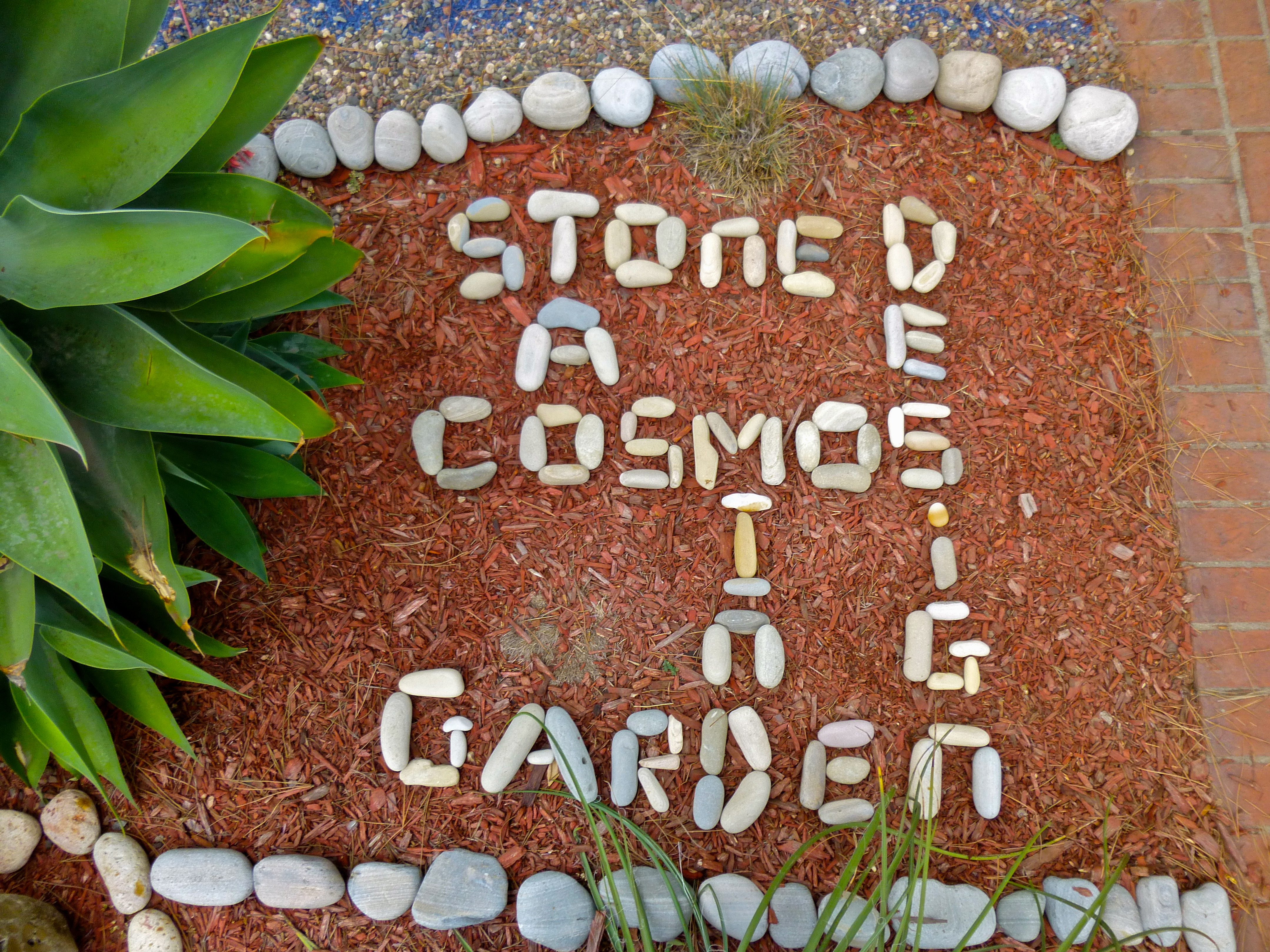
Pierre Jardin's stoned thinking follows lines suggested by the Taoist view that rocks represent the universe in miniature, or more precisely, the inchoate energies that created the universe. This petriverse connects the words Tao, stone, mind, cosmos, garden and design into a lattice-like figure meant to resemble or evoke a written Chinese character. It is read both horizontally and vertically, similar to how one reads the hexagrams of the I Ching. The words express a vision that stone design in the garden is a way for the mind to merge with the cosmos and thus feel intensively the Tao.