This page was created by Multiple Authors. The last update was by Paul A. Harris.
Multi-Modal-Media
…what is hidden from us is not something rare and occult, or even augustly sacred, but, too often, the Earth we stand on. I present to you a new word: “geophany.” A theophany is the showing forth, the manifestation of God, or a god; geophany therefore must be the showing forth of the Earth. –Tim Robinson
The Petriverse is designed to cultivate aesthetic appreciation for stone and the wonders of Earth. Pierre Jardin propagates the Petriverse in lithic, digital and print media. A large, square, flat mudstone serves as a plaque that bears the garden's name, with a rock in which a purple portrait of Pierre Jardin's Munch-like melting face may be made out.
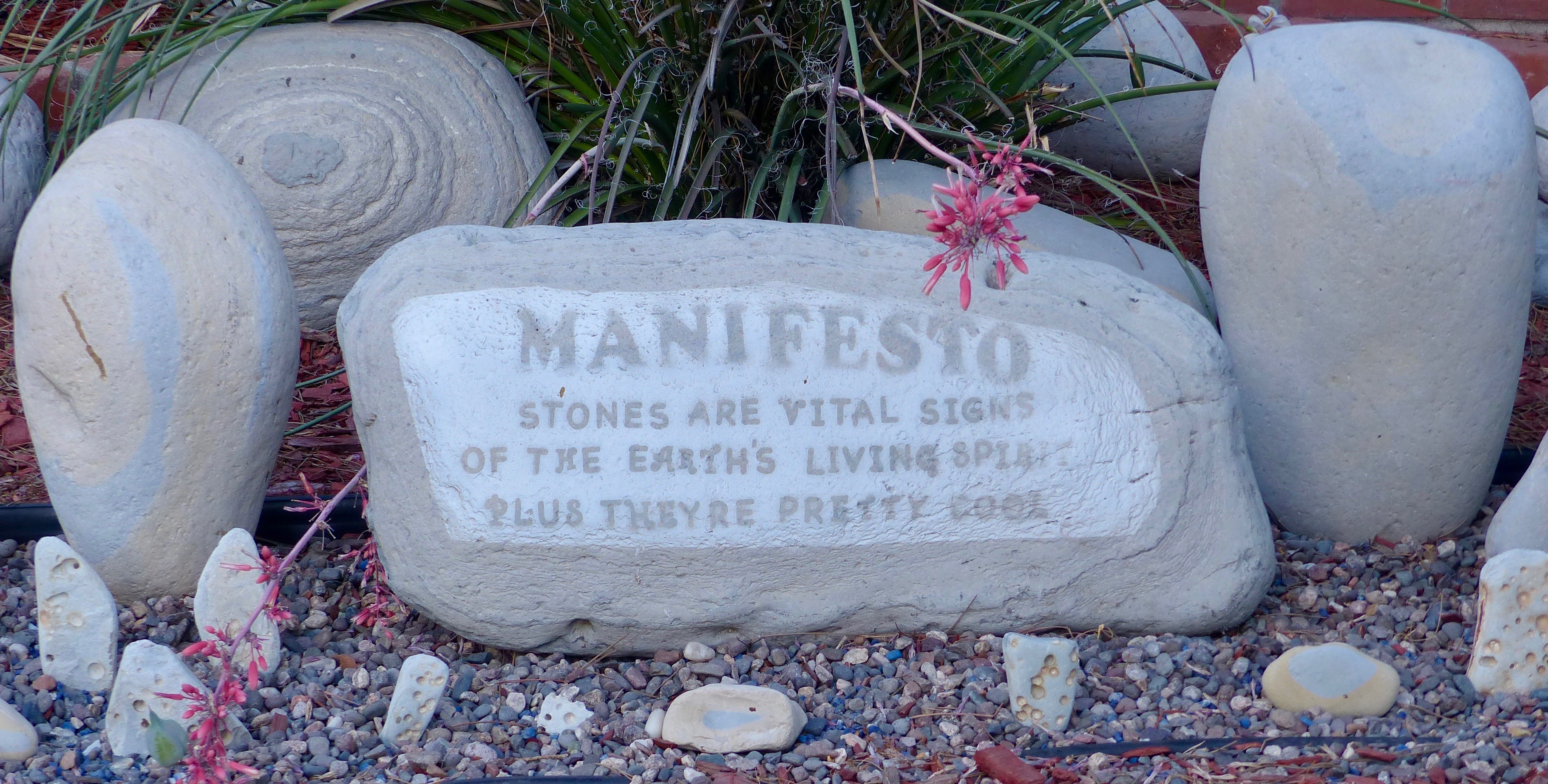
A "Manifestone" broadcasts the garden's flat ontology in a lighthearted haiku: "Stones are vital signs/ of the earth's living spirit/ plus they're pretty cool." Jardin casts stones as the planet's pulse and breath, while obliquely echoing Ralph Waldo Emerson's pseudo-syllogism in Nature: "Words are signs of natural facts; Particular natural facts are symbols of particular spiritual facts; Nature is the symbol of spirit."
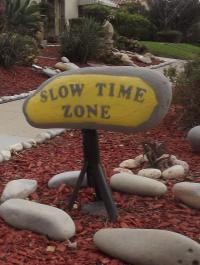
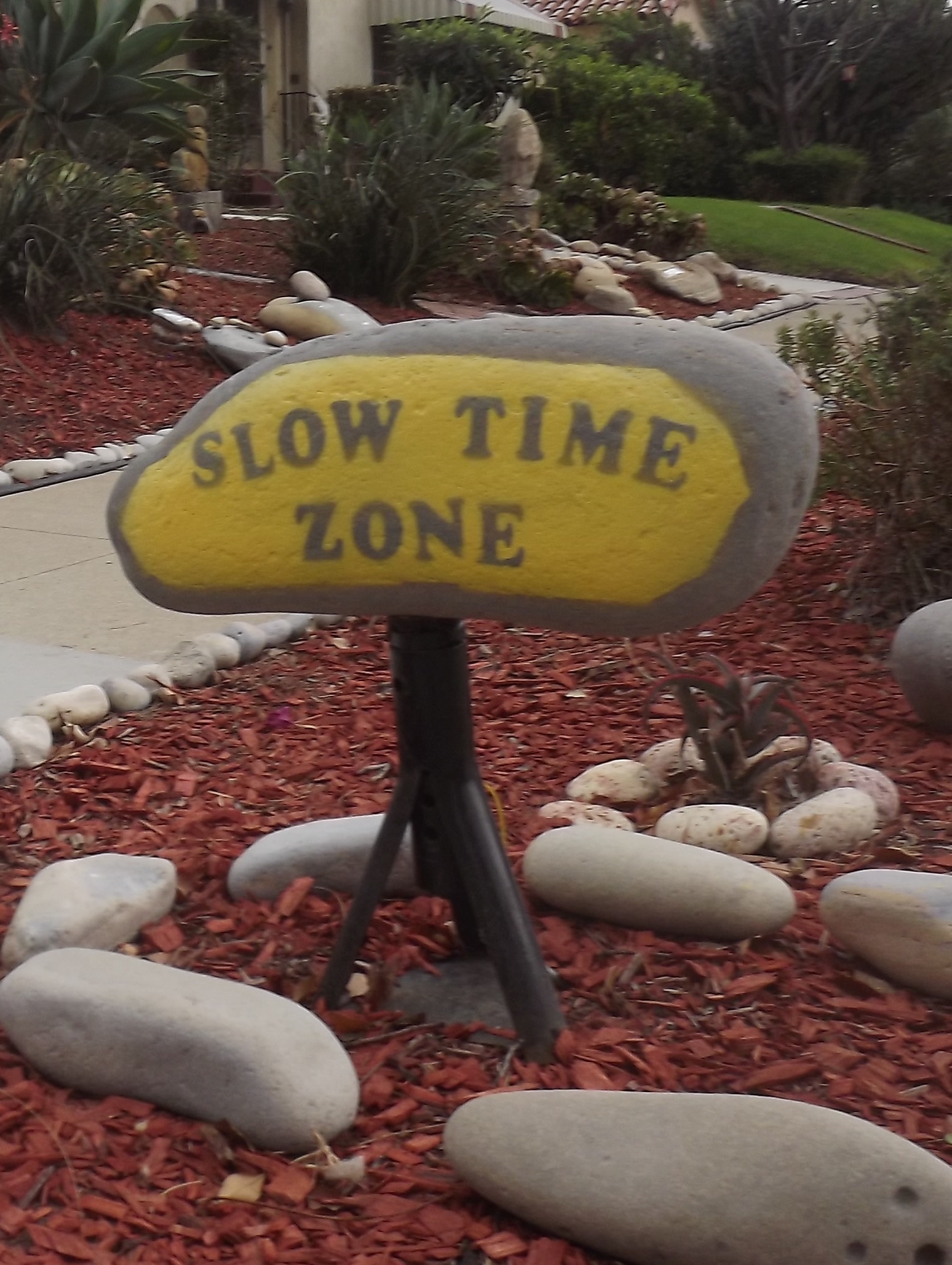
Large stones spray-painted roadsign-yellow inform pedestrians that they are passing through a "SLOW TIME ZONE."
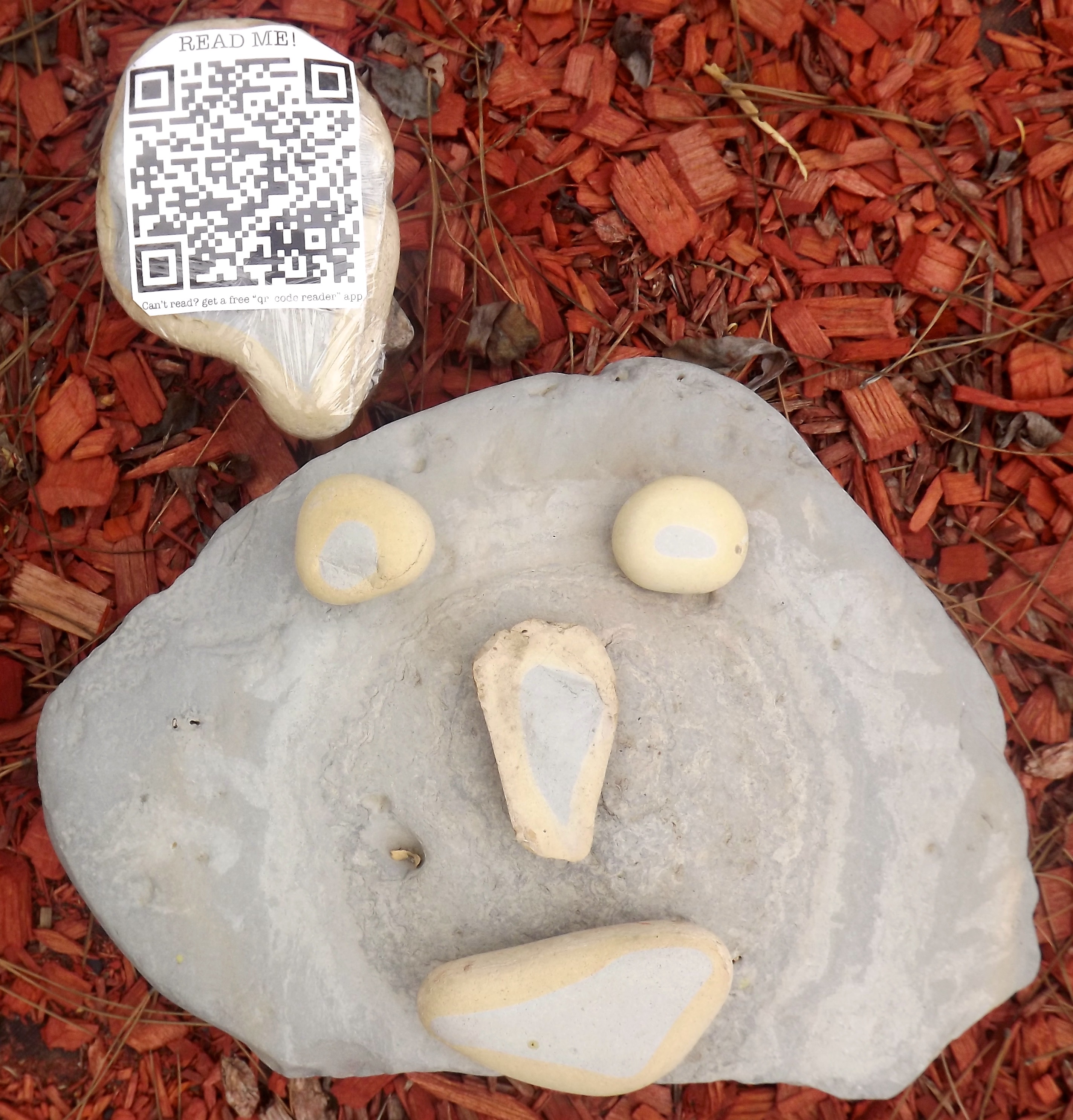
An eponymous blog features photos and writings about Petriverse displays, while also providing a platform Pierre Jardin to disseminate his research and thoughts about stone more generally. A display with a QR code allows garden visitors to access the blog and read about the garden. Particularly interesting developments in the garden are chronicled in a newsletter called The Slow Times, made available in print (document box in garden) and on the Petriverse blog.
Pierre Jardin aspires to reveal the too-often hidden or forgotten beauties of stone and earth, to decontextualize and defamiliarize rocks just enough for their familiar presence to assert itself anew in a new context. As George Quasha observes, “there are two kinds of stones. There are the immediately obvious extraordinary ones, stones beautiful or strange or otherwise powerful in themselves…. Then there are the invisible stones, the stones we see as stone… These stones rarely appear as themselves." In rock-fishing and displaying stones, Jardin works to discern distinctive qualities in “invisible” stones, and then create compositions so that they “appear as themselves.” In the events of this appearing—which happens when children stop and point at particular stones, or when parents inquire how and where the “unusual” rocks were acquired—the Petriverse becomes a “geophany," a showing forth of the earth.

This page has paths:
- A World Composed of Rocks Paul A. Harris