The Petriverse of Pierre Jardin: by Paul A. Harris

Sky & Sea

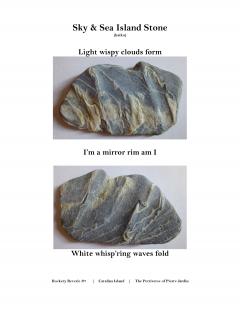
This haiku also plays on a deictic anchoring, a verbal self-referentiality to mark a present context from which a poem emanates and encompasses different earthly rhythms and natural processes. The stone was found at Little Harbor campground on Catalina Island off the coast of Southern California. It is a piece of blueschist, "a signature rock produced by low temperature-high pressure metamorphism in a subduction zone" (Meldahl, 86). The island attracts striking formations of clouds and waves in the skies above and the seas below. This stone microcosmically compresses all these images and forces and contains them. The deep ocean color and brittle hardness make the stone seem as if formed when waves met lava, the water turning the red molten flow blue.  The white lines on its two faces, as you flip the stone to look at first one and then the other side, recall the days on the island spent watching clouds and waves.  

This Rockery Reverie is a hybrid of haiku and Chinese couplet. Like the haiku, the Chinese couplet is aphoristic and evocative. The Chinese couplet has two equal-length lines of four to seven characters which mirror one another in (inverse or identical) tone patterns, and corresponding characters in the two lines must have the same lexical category (noun-noun, verb-verb, etc.). Following the Chinese form, in the Rockery Reverie poem the words in the first and last lines echo one another in structure, sound, and lexical category. While these lines evoke the sky above and water below, the middle line speaks as and for the island itself, harbored in the stone.  It is thus a reflective surface, a passage where the rock flips from one side to the other.  The middle line announces itself as such in content (a mirror) and form (a palindrome).
 

This page has paths:

  1. Rockery Reveries Paul A. Harris

This page references: