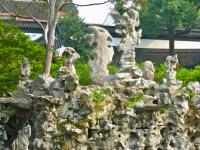
Rocks and Water, Large and Small
Rocks, individually situated or piled into rockeries, evoke mountains. Scaling, producing nature in miniature, is an important design principle in Chinese gardens. In an oft-cited 18th century treatise by Shen Fu, he writes that “in piling up rocks into mountains…the aim is to see the small in the large, to see the large in the small, to see the real in the illusory and the to see the illusory in the real” (in Jencks 1978, 196). Rocks and rockeries were more than visual evocations of mountains: as Parkes writes, “rocks are thought to partake of the powers of the mountain less through their resembling its outward appearance than for their being true microcosms, animated by the same energies that formed the heights and peaks.”
This page has paths:
- Chinese Lithophilia Paul A. Harris